

























































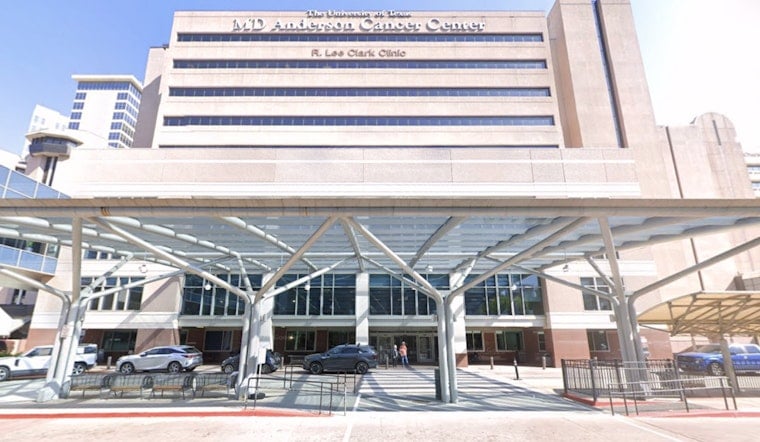
A married couple who both worked as instructors at UT MD Anderson Cancer Center are under criminal investigation after a search warrant alleged that one of them transferred more than 3 terabytes of biomedical research data to a personal external hard drive. The warrant also describes an alleged side freight forwarding business the pair ran out of their home, a venture that would have violated the terms of an H-1B visa.
The allegations, first detailed in a search warrant obtained by KPRC Click2Houston, say the MD Anderson instructor connected a personal hard drive to an MD Anderson laptop on July 31 and copied files from a shared MD Anderson drive onto the device. Investigators say the hard drive was connected around 12:35 p.m., ejected at 12:41 p.m., then reconnected at 5:23 p.m. when another batch of files was transferred, according to the affidavit. The University of Texas Police Department is leading the case, though the department had not responded to a request for comment at the time Click2Houston published its report.
The transferred data allegedly included genomic research data, experiment files, manuscripts, presentations, biomedical research folders and documents tied to federal research grants, per the search warrant. Both instructors worked in MD Anderson's molecular oncology and experimental radiation oncology departments and were placed on paid administrative leave on July 31, the same day the alleged transfers occurred.
A Warrant, a Home Business and an H-1B Visa
Beyond the data transfer itself, investigators say they were also looking into the couple over an alleged freight forwarding business operated out of their home, which records reviewed by investigators suggest may have included counterfeit goods. Because H-1B visas authorize holders to work solely for their petitioning employer, running an unapproved side business would have put the couple's immigration status at risk; federal rules under 8 CFR § 214.2(h) treat unapproved secondary business activity as grounds for revocation, according to the American Immigration Lawyers Association. An H-1B visa is a temporary, employer-sponsored work visa reserved for people in specialized fields requiring at least a bachelor's degree.
Investigators wrote that the couple's alleged conduct fit a pattern they have seen before: employees facing dismissal and the possible loss of their visas moving to abscond with intellectual property, according to the search warrant. The affidavit also states that a document allegedly reviewed by one of the employees contained questions about leaving the United States to return to China while the investigation was still pending. The warrant does not indicate that the research data was sold, shared or transferred outside the United States, and it does not state that either employee was fired or dismissed.
Search Warrant Executed at University Housing
Law enforcement executed the search warrant on August 17 at an apartment inside UT Health Houston university housing, seizing computers, phones, external hard drives and other electronic devices. Those devices are expected to be sent to forensic specialists for further examination, and investigators have been conducting forensic reviews for evidence of alleged trade-secret theft or other criminal activity. KPRC 2 News is not naming the employees targeted in the investigation, and MD Anderson has not provided an update on the couple's current employment status.
MD Anderson said it is working with relevant authorities and has taken steps to protect the institution's data, though the cancer center did not detail what those steps involve. The couple is now facing both a criminal investigation and an internal compliance investigation, a dual-track process that mirrors how MD Anderson has handled at least one other recent case.
Not MD Anderson's First Brush With Trade-Secret Allegations
This is not the first time MD Anderson has confronted allegations of research data walking out the door. In a case Hoodline covered earlier this year, former MD Anderson breast cancer researcher Yunhai Li was sentenced to 364 days in the Harris County jail after pleading guilty to a state jail felony count of attempted theft of trade secrets, for downloading research data onto personal devices and allegedly attempting to take it to China. Li resigned amid an internal compliance probe before being apprehended at Bush Intercontinental Airport, according to the Houston Chronicle.
Texas lawmakers have since raised the stakes for cases like these. Under Texas Penal Code § 31.05, theft of trade secrets is a third-degree felony carrying two to ten years in prison, but as of September 1, 2025, the offense becomes a second-degree felony carrying two to twenty years if committed with intent to benefit a foreign agent or foreign entity, according to FindLaw. Separately, federal law under 18 U.S.C. §§ 1831 and 1832 allows for penalties of up to ten years for commercial trade-secret theft and up to fifteen years plus organizational fines of as much as $10 million for economic espionage benefiting a foreign government, per the Congressional Research Service. It remains unclear whether prosecutors will pursue any enhanced state charge or whether federal authorities will file parallel charges in this case.
MD Anderson's compliance troubles date back further than the Li case. In April 2019, the cancer center ousted three senior researchers following National Institutes of Health inquiries into undisclosed foreign funding from China and breaches of peer-review confidentiality, as reported by The Scientist. That scrutiny came amid a period when MD Anderson managed enormous federal research funding, having received $148 million in NIH grants in 2018 alone, according to KRGV. Criminal investigations into higher-education trade-secret theft in Texas, including the Li case, have also involved the Texas Department of Public Safety working alongside campus police departments, per Texas Scorecard.
An Institution in the Middle of Rapid Expansion
The investigation lands as MD Anderson continues an aggressive campus buildout. In May, the University of Texas System Board of Regents approved a $2.9 billion expansion for a 25-floor patient tower in the Texas Medical Center, a project Hoodline reported would reinforce the cancer center's status as one of the world's leading research institutions. That followed a March 2024 decision by UT System regents to approve a separate $2.5 billion project building an MD Anderson site in Austin alongside a new UT Austin specialty hospital. Whether any of the allegedly transferred data was moved off-site before devices were seized remains an open question in the current investigation.




